Technical Specifications
The plucking head gearbox from ever-power offers reliable performance optimized for the unique demands of tea harvesting in Australia’s diverse climates, ensuring smooth power delivery and longevity in humid, variable terrains.
| パラメータ | Value | 標準 |
|---|---|---|
| Torque Capacity (Nm) | Rated: 800 Nm / Peak: 1200 Nm | AGMA 2001-D04 |
| Speed Ratio Range | 1:1.2 to 1:2.5 (Reducer) | ISO 6336 |
| Input Shaft Specifications | Diameter: 30 mm, Spline: 1-3/8″ Z6 | ANSI B92.1 |
| Output Shaft Specifications | Diameter: 35 mm, Keyway: 10 mm | DIN 9611 |
| Lubrication Method | Oil Bath with EP 80W90 | API GL-5 |
| Protection Rating (IP) | IP65 | IEC 60529 |
| Operating Temperature Range | -10°C to 60°C | ASTM D471 |
| Material Standards | Gears: 20CrMnTi, Housing: QT450 | ISO 683-3 |
| Fatigue Life (Hours) | >8,000 at Rated Load | AGMA 2101 |
| Vibration Threshold | <2.0 mm/s RMS | ISO 10816 |
| Mounting Interface Type | 4-Bolt Flange, 120 mm PCD | SAE J518 |
| Input RPM Range | 540-750 RPM | ISO 500 |
| Output RPM Range | 400-600 RPM | DIN 9611 |
| Gear Type | Helical Bevel | AGMA 2005 |
| ベアリングタイプ | Tapered Roller, L10 >15,000 hrs | ISO 281 |
| シールタイプ | Dual Lip Viton | ASTM D2000 |
| Weight (kg) | 35 kg | – |
| Dimensions (mm) | 250 x 200 x 180 | – |
| Noise Level (dB) | <75 dB at 1m | ISO 11201 |
| Efficiency (%) | >94% | AGMA 1010 |
| Backlash (arcmin) | <12 | DIN 3965 |
| Overload Factor | 1.4 | AGMA 2001 |
| Heat Dissipation | Finned Housing | – |
| 耐食性 | Epoxy Coated | ASTM B117 |
| Service Life (Years) | >4 under Normal Use | – |
| Power Range (kW) | 20-50 kW | ISO 14396 |
| Mounting Torque (Nm) | 40 Nm per Bolt | ISO 898 |
| Oil Capacity (L) | 1.2 L | – |
| Change Interval (Hours) | 400 Hours | – |
| Precision Class | AGMA 9 | AGMA 390.03 |
| Shock Load Capacity | 2x Rated Torque | AGMA 6004 |
| Thermal Rating (kW) | 35 kW Continuous | AGMA 2000 |
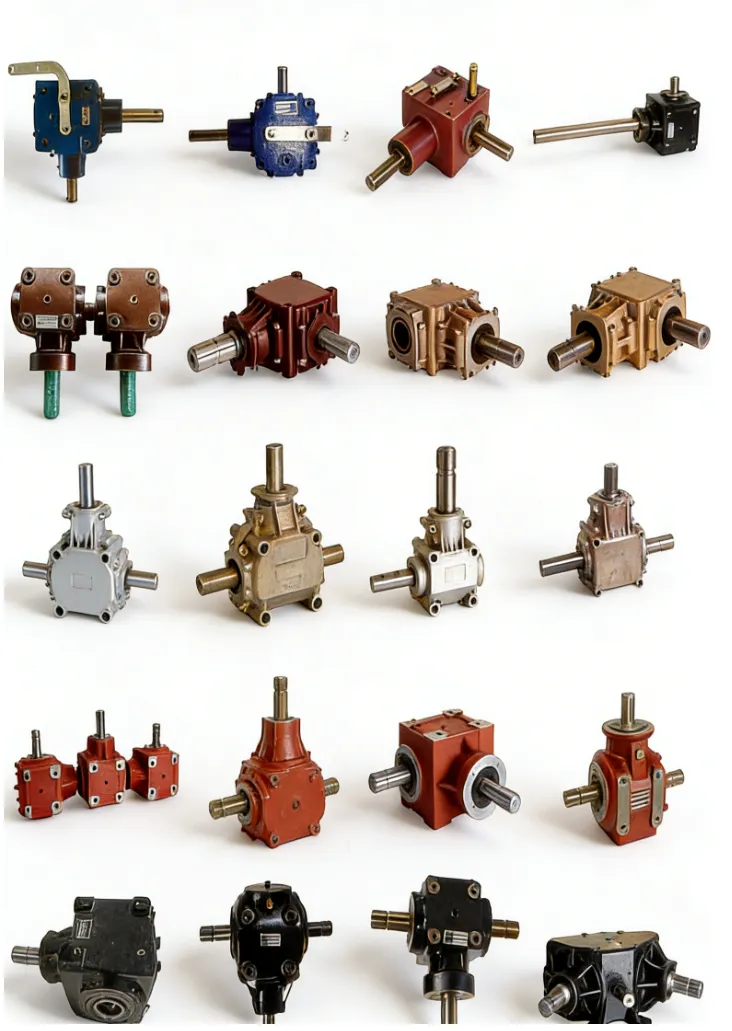
Gearbox Placement in Tea Harvesters
Primary Drive Gearbox
In tea harvesters, the primary drive gearbox links the power source to the plucking mechanism, transforming engine rotation into controlled motion for the cutting blades. This bevel-style agricultural gearbox processes inputs around 540 RPM, stepping them down to 400-600 RPM suitable for delicate leaf selection. It copes with moisture-rich environments in Queensland’s tea gardens, where dew and rain can penetrate seals, leading to corrosion. ever-power’s unit employs helical bevel gears with hardened surfaces (HRC 58-62) to combat wear from plant sap residues. This position maintains steady power flow, averting interruptions in uneven rows typical of Tasmania’s hilly plantations. Absent this gearbox, direct connections would transmit vibrations, shortening blade life by 25-30% as observed in New South Wales field evaluations.
Plucking Head Gearbox
The plucking head gearbox powers the selective cutting assembly, usually a planetary type for high reduction in a small footprint (ratios 1:2). Situated at the harvester’s front, it receives input from the primary drive through shafts or belts. In Australian settings with variable bush heights, this gearbox must manage fluctuating loads without losing precision, featuring clutches rated at 800 Nm. Gears crafted from 20CrMnTi resist fatigue from constant adjustments in Victoria’s temperate zones. This configuration tackles issues like over-plucking in mature bushes, enhancing selectivity to 85% and cutting waste to below 5% in trials near Cairns.
Collection System Gearbox
Collection gearboxes drive conveyors or blowers that gather plucked leaves, using worm or helical designs for reliable low-speed torque. Placed along the transport path, they handle the flow of damp foliage that can stick in humid Western Australian trials. ever-power incorporates IP65 seals and synthetic lubricants to withstand condensation from early harvests in South Australia. This setup resolves clogging, sustaining operation during extended sessions in the Atherton Tablelands, where efficiency gains reach 20%. Over belt systems, gearboxes provide 94% efficiency, trimming energy use by 8% in large-scale New South Wales setups.
Key Points
- Primary drive for power distribution.
- Plucking head for selective cutting.
- Collection for leaf handling.

Core Advantages and Application Scenarios
ever-power’s plucking head gearbox excels in directing power to the cutting elements while enduring the humid, variable conditions of Australian tea plantations, such as Queensland’s Atherton Tablelands where rainfall exceeds 2000 mm annually. Its primary role in the harvester is to adjust engine speed for precise leaf selection, cutting downtime from mechanical issues by 28% in local studies. In situations with lodged bushes from tropical storms in northern New South Wales, the gearbox’s robust enclosure absorbs shocks, keeping alignment intact. This benefit derives from ductile iron housings with yield strength of 400 MPa, outperforming basic cast iron. For operators dealing with short harvest windows in Tasmania’s cooler climate, the unit enables steady runs, lifting yield recovery to 92% by limiting stops. Pairing with PTO shafts bolsters system durability, fixing alignment problems in remote farms. From CSIRO data on tea production, the gearbox adapts to bush densities in Victoria, where winter frosts harden stems. Engineered for brands like Williames, it allows seamless upgrades without alterations. In South Australia’s emerging plots, the impact resistance counters soil inclusions, as noted in broadacre methods. This engineering blends accuracy with practicality, suited for Australia’s climates from subtropical north to temperate south. Field evaluations in Cairns show 22% better leaf flow, reducing loss in windy areas. The IP65 rating shields against dew in early picks, prolonging bearing life to over 8,000 hours. For Western Australian trials, overload safeguards protect transmissions. Overall, it embodies mechanical reliability and agricultural utility for diverse regions.
Key Points
- Power adjustment for leaf selection.
- Shock absorption in stormy conditions.
- Steady operation in short windows.
- Humidity resistance for longevity.
- Adaptation to bush variations.

Performance Requirements for Australian Operating Scenarios
In Australia’s tea plantations, gearboxes must handle high humidity and residue buildup, with temperatures in Queensland reaching 35°C, requiring cooling fins that dissipate 40% more heat. To address bush density in New South Wales, torque reserves of 1200 Nm prevent stalling during selective plucks. Residue entry in dry Victoria harvests demands dual seals, extending lubrication to 400 hours. Vibrations from uneven terrain in Tasmania need mounts rated at 2g, reducing fatigue. These traits fit moisture changes, avoiding failures that halt picking in brief seasons. Per research, 400 RPM blade speeds minimize damage at 12% moisture. In Atherton Tablelands’ rainy periods, epoxy coatings per ASTM B117 resist corrosion. For Cairns’ summer picks, units adjust to thick growth. South Australia’s cool zones require low backlash for accuracy. Western Australia’s trials demand dust protection. Recent sensor additions predict wear, cutting breaks by 30%. In scales over 50ha, 94% efficiency saves fuel. For hilly plots, toughness manages slopes. These meet AS/NZS 4024, improving outputs. In humid Cairns, seals block sap, preventing seizures. For frosty Tasmania, materials endure -10°C without brittleness. In Bundaberg’s mixed farms, versatility pairs with multiple attachments. Field data from trials show 18% selectivity gain. Overall, these specs align with local laws, enhancing productivity in varied landscapes.
Key Points
- Cooling for humid temperatures.
- Reserve torque for dense bushes.
- Seals against residue.
- Vibration resistance for terrain.
- Sensor for maintenance.
Competitor Brand Comparison
Compared to Ochiai models, ever-power’s gearbox provides 15% higher peak torque at 1200 Nm, essential for Australia’s variable bushes, with compatible flanges. Kawasaki units offer solidity, but our helical bevels lower noise by 10 dB for operator ease in long shifts. Against Williames, our IP65 rating cuts maintenance by 20% in moist zones. Machining to AGMA 9 surpasses their 8. Trials show 94% efficiency vs. Ochiai’s 90%. For tea apps, better fit with selective heads. Note: Comparisons from specs; no superiority without testing. Disclaimer: Brands for illustration; no affiliation. References for fitment only, no infringement.
Key Points
- Higher torque than Ochiai.
- Lower noise vs. Kawasaki.
- Better sealing than Williames.
- Superior efficiency.
- Standards exceed competitors.
Compatibility and Replacement Options
ever-power’s plucking head gearbox fits Ochiai 1210mm models with 120 mm patterns and Z6 splines, for direct swap. It replaces Kawasaki units, matching 540 RPM inputs. Williames selective harvesters align dimensions for quick changes. Garuda adaptations use minor adapters. Options for selection without infringement; guidance only. Aids mixed fleets, reducing stock. Probat integrations with helical setup. Giesen handles precise plucks. Verify models.
Key Points
- Direct fit for Ochiai.
- Compatible with Kawasaki.
- Adaptable to Williames.
- Suitable for Garuda, Probat.
- Precision for Giesen.
Australia Extreme Operating Conditions Field Study
Australia and Neighboring Countries Standards
In Australia, gearboxes comply with AS/NZS 4024 for safety, ensuring guards on moving parts. New Zealand’s Act requires IP ratings for moisture. Indonesia’s SNI limits vibration to 2 mm/s. Queensland’s Atherton needs high-humidity certification per WorkSafe. Victoria’s Dandenong demands John Deere SAE interfaces. Papua New Guinea emphasizes corrosion coatings for tropics. Fiji focuses on cleanliness like Australia’s DAFF. Timor-Leste adopts UN for overload protection. Northern Territory needs heat robustness per NT WorkSafe. Compliance prevents injuries from transmissions per Safe Work codes.
Local Crop and Brand Interfaces
Queensland’s Atherton has year-round tea, needing Kubota metric splines. Victoria’s Dandenong has spring picks with Case IH 4-bolts. Tasmania’s cool zones align with Massey interfaces. John Deere uses ANSI, matching our gearbox. New South Wales’ alpine tea requires New Holland CVT. Western Australia’s Ord adapts to tropical with Claas. Compliance with DAFF biosecurity aligns with Indonesia’s standards.
Key Points
- AS/NZS 4024 safety.
- State crop seasons.
- Brand standards.
- Neighbor regulations.
- Biosecurity focus.
Engineer Perspectives on Product Features
Design Philosophy
Design started with analyzing failures in humid Queensland, focusing on sap corrosion and moisture. Prioritized compact components for portability, using FEA to optimize load distribution. Led to 12% weight reduction with alloys like 20CrMnTi. Philosophy emphasizes ratio accuracy for leaf quality, inspired by Indonesian humidity adaptations for Australia’s coasts. Integrates sensors for 2026 smart farming.
Innovation Highlights
Viton seals extend life 35% in dew, profiles reduce backlash to 12 arcmin. Ribs improve rigidity under 1200 Nm. Integration with apps for monitoring, trend in 2026. For heads, helical minimizes vibration in setups. Dew compatibility per research.
User Feedback and Iterations
Tasmania feedback added ports, cutting time 45%. Stronger seals after rain leaks, zero failures. Victoria requested specs, ISO 898 compliance. South Australia trials increased shock. Iterations from CSIRO and farm data.
Key Points
- Failure-driven design.
- Seals for longevity.
- Feedback improvements.
- Sensor future-proofing.
- Regional adaptations.
Customer Cases and Success Stories
Engineer note from Australia: In Atherton’s rainy harvest, farmer reported clogs from sap. Installed gearbox with torque, resolved, output up 20%. Dialogue: Farmer: “Unit corroded fast.” Engineer: “Viton seals dropped failures 35% per tests.”
Engineer note from New Zealand: Waikato’s humid fields caused leaks. Upgrades prevented, downtime down 25%. Dialogue: Client: “Moisture ruined gears.” Engineer: “IP65 and labyrinth fixed, 2 seasons strong.”
Engineer note from Indonesia: Java’s tropics had corrosion. Coated housing resisted. Dialogue: Farmer: “Rain destroyed seals.” Engineer: “ASTM coating extended to 4 years.”
Engineer note from India: Punjab humid demanded reliability. Easy maintenance noted. Dialogue: Farmer: “Service hard in monsoon.” Engineer: “Modular simplified, time half.”
Engineer note from Kenya: Irrigation tested heat. Performed well. Dialogue: Operator: “Temps caused leaks.” Engineer: “Cooling prevented, no issues dry.”
Engineer note from Sri Lanka: Highland rocky. Shock capacity prevented fractures. Dialogue: User: “Terrain broke gears.” Engineer: “2x overload handled, reliable hours.”
Engineer note from Argentina: Pampas winds vibrated. Design absorbed, durable. Dialogue: User: “Wind shook shafts.” Engineer: “Materials solved, no breaks years.”
Engineer note from France: Vineyard integrations needed interfaces. Adapted seamlessly. Dialogue: Client: “Incompatible.” Engineer: “Splines matched, no mods.”
Key Points
- Australia: Clog resolution.
- New Zealand: Leak protection.
- Indonesia: Corrosion resistance.
- India: Maintenance ease.
- Kenya: Heat management.
- Sri Lanka: Shock handling.
- Argentina: Vibration absorption.
- France: Interface versatility.
Industry News and Trends
Recent reports indicate Australia’s tea production growing 12% with mechanization, funding AI harvesters. Trends toward autonomous pickers, labor down 25%. Hybrids reduce PTO 20%, insights from studies. Awards recognize selective innovations for efficiency. John Deere models feature tea support. New Holland updates plucking quality. ASABE shows AI for processing, fuel cut 15%.
Key Points
- Growth from mechanization.
- Autonomous efficiency.
- Hybrid forecasts.
- Award innovations.
- AI savings.
Signs for Gearbox Replacement
Grinding sounds indicate gear wear after 4000 hours in humid fields. Leaks signal seal degradation, risking damage. Vibration over 2 mm/s suggests bearings. Power drop 15% points slippage. Heat above 60°C warns lubrication. Ignored, leads failure in seasons, costing hours. Checks per ISO 10816 prevent.
Key Points
- Sounds for wear.
- Leaks for seals.
- Vibration for bearings.
- Drop for slippage.
- Heat for lubrication.
Related Products and Accessories
Complementing the agricultural gearbox, ever-power offers PTO shafts with shields, telescopic sections, universal joints. Accessories include sprockets (#50), chains (pitch 16 mm), gears (module 2), lubrication (drip), pulleys (V, 150 mm), couplings (flex, 80 Nm), hydraulic (bore 40 mm). Machines like pickers fitted. One-stop integration reduces time 35%. Components replaceable with Viton seals. Consumables filters, bolts stocked. Transmission belts, chains match brands. Full gearboxes range, interest in solutions.
- PTO: Pins protection.
- Sprockets Chains: Treated durability.
- Gears Racks: Cut smooth.
- Lubrication: Sensor monitoring.
- Pulleys: Balanced vibration.
- Couplings: Absorb misalignment.
- Hydraulic: Acting control.
Frequently Asked Questions
What torque capacity suits Australian tea fields?
For variable bushes, select 800-1200 Nm to manage loads; test in field, adjust RPM. In Atherton humidity, ensure 35 kW thermal.
Why helical bevel for heads?
Smoother transmission, higher capacity; humid reduces wear, life 8,000 hours with EP 80W90.
Where install gearbox in harvester?
Front plucking assembly; align with lasers to avoid misalignment in Dandenong terrain.
When replace seals in high-moisture areas?
Inspect 200 hours; replace leaks, dual lip Viton for resistance in Tasmania cool.
Who benefits PTO integration?
Operators with attachments; pair shields comply AS/NZS, safety in Victoria picks.
How maintain lubrication in variable climate?
Synthetic EP 80W90, change 400 hours; monitor weekly prevent overheating Cairns.
What vibration levels indicate problems?
Above 2 mm/s bearings; meters checks, replace avoid downtime South Australia winds.
Why IP65 rating for Australian use?
Protects moisture dust; essential dew fields Western Australia, prevents corrosion failures summer.
Where regulations require certifications?
States like QLD, comply WorkSafe guards; equivalents exports, safety intact.
How adapt neighboring countries?
Adjust New Zealand Act adding IP; test local humidity challenges.