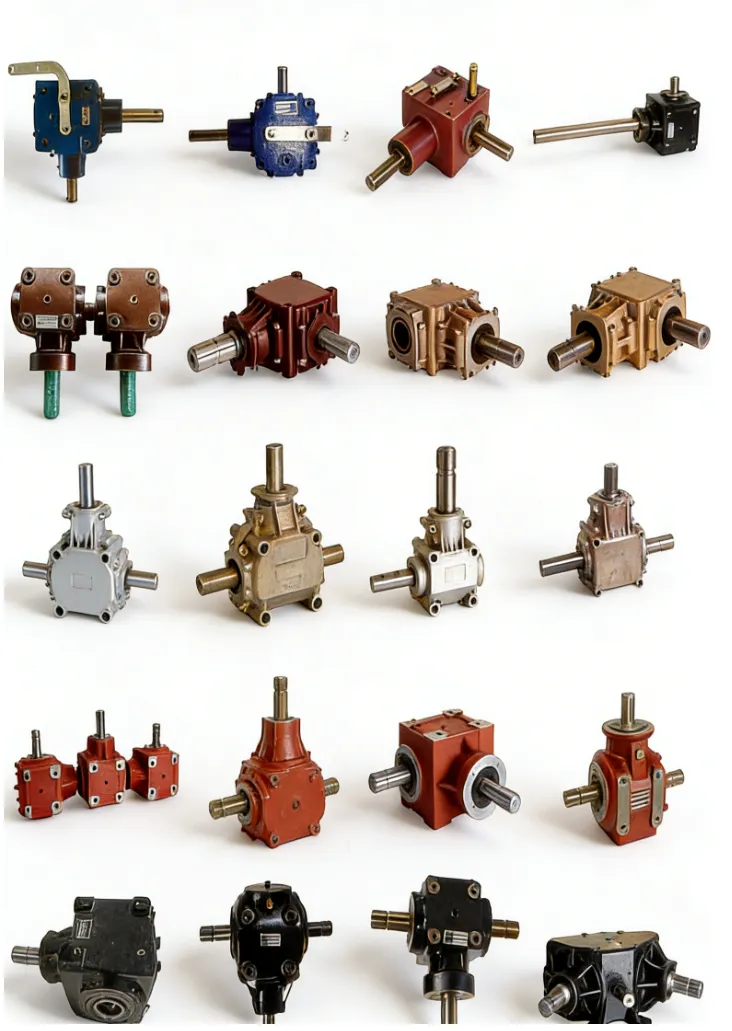
Australian peanut growers in the Atherton Tablelands (Queensland), Kingaroy region and emerging areas of northern New South Wales rely on self-propelled and tractor-mounted peanut harvesters to lift, shake, invert and windrow pods during the April–June harvest window. The picking mechanism gearbox — typically a right-angle bevel or planetary unit — sits at the heart of the picking head, transmitting power from the side PTO or hydraulic motor to four to six counter-rotating picking shafts. It enables precise speed matching between upper and lower picking fingers, ensuring clean pod detachment with minimal soil carry-over and pod damage in the red volcanic soils and variable moisture conditions typical of Queensland’s dry tropics.

Technical Specifications
Ever-Power picking mechanism gearboxes are designed to deliver smooth, backlash-free torque transmission and long fatigue life under the high lateral vibration and intermittent shock loads encountered during peanut lifting in Australian conditions. The table below presents 31 representative parameters for gearboxes matched to 4–8 row commercial peanut harvesters (typical throughput 8–18 t/h fresh pods).
| Parametro | Value / Range | Notes / Reference Standard |
|---|---|---|
| Rated Output Torque (per shaft pair) | 1 200 – 4 800 Nm | Continuous at 180–420 rpm picking shaft speed |
| Peak Torque Capacity | 2 400 – 9 600 Nm | Short-term stone / root impact |
| Speed Ratio Range | 1.8:1 – 4.2:1 | Right-angle reduction |
| Input Speed Range | 540 – 1 000 rpm | Standard tractor PTO or hydraulic motor |
| Output Speed Range (shaft) | 180 – 520 rpm | Adjustable for pod maturity |
| Mechanical Efficiency | 92–96 % | Spiral bevel + helical stages |
| Backlash (output) | ≤ 0.18° – 0.45° | Adjustable pre-load |
| Axial Load Capacity (dynamic) | Up to 42 kN | Soil resistance on picking fingers |
| Radial Load Capacity | Up to 28 kN | At shaft centre |
| IP Protection Rating | IP66 – IP68 | High-pressure wash-down |
| Operating Temperature Range | -12 °C to +68 °C | Queensland tropical harvest |
| Housing Material | QT500-7 ductile iron | Improved elongation vs QT450 |
| Gear Material (bevel) | 20CrMnTi carburised | Case depth 1.5–2.0 mm |
| Gear Material (helical) | 18CrNiMo7-6 | HRC 60–63 |
| Lubrication Type | ISO VG 320–460 synthetic | Oil bath with magnetic plug |
| Oil Volume | 2.8–7.4 L | Dependent on row count |
| Fatigue Life (L10) | > 22 000 h | At 65 % rated load |
| Noise Level (1 m) | ≤ 72 dB(A) | No-load |
| Vibration Velocity (RMS) | ≤ 3.8 mm/s | ISO 10816-3 |
| Input Shaft Diameter | 38–55 mm | 6-spline or keyed |
| Output Shaft Diameter (per side) | 45–68 mm | Double output design |
| Mounting Interface | 4-bolt rectangular flange | Common peanut header pattern |
| Weight (dry) | 68–195 kg | 4-row to 8-row models |
| Service Factor (SF) | 1.75–2.4 | Intermittent soil impact |
| Thermal Power Rating | 45–135 kW | Without external cooling |
| Surface Corrosion Class | C5-M | ISO 12944 coastal exposure |
| Bearing L10 Life | > 30 000 h | SKF / NSK equivalent |
| Seal Configuration | Triple-lip + labyrinth | Soil & water exclusion |
| Overload Protection | Integrated slip clutch | Adjustable torque limiter |
| Compliance Reference | AS/NZS 4024 series | Australian machinery safety |
| Shaft Parallelism Tolerance | ≤ 0.03 mm / 100 mm | Factory measured |
Mounting Locations, Working Principle and Core Functions
The picking mechanism gearbox is normally mounted transversely on the front of the header frame, immediately behind the digging/lifting shares. Power enters via the input shaft from either a side-mounted hydraulic motor or a mechanical drive taken from the combine/tractor PTO through a chain or belt.
Power Path and Speed Matching
Input torque is transferred 90° through a spiral bevel stage, then split to two or four output shafts via helical gears or idler gears. Each output shaft drives a pair of counter-rotating picking shafts fitted with rubber fingers or steel tines. The gearbox maintains a fixed speed differential (typically 1.05–1.15:1) between upper and lower shafts to optimise pod stripping without excessive vine wrapping or soil disturbance in the friable red ferrosols of the Atherton Tablelands.
Shock Absorption and Protection
Integrated torque limiters or shear-bolt hubs protect gears from sudden overloads when picking fingers strike rocks or hard soil clods — a frequent occurrence in fields previously deep-ripped for peanuts in Queensland. The bevel pinion is often mounted on a floating bearing arrangement to reduce side-load stress during header tilt on uneven ground.
Vibration & Misalignment Management
Output shafts are supported by heavy-duty spherical roller bearings in cartridge housings, allowing limited misalignment from frame flex. This design reduces bearing edge loading when the header follows ground contours at 4–7 km/h forward speed.
Queensland Peanut Belt Extreme Operating Conditions Field Study
Peanut harvesting in Queensland’s Burnett and Atherton regions exposes picking gearboxes to unique challenges: red volcanic soils with high iron content (abrasive to seals), temperatures reaching 38–42 °C with relative humidity frequently > 70 %, short harvest windows (late April to mid-June), and high stone content after laser-levelling or deep ripping. Average daily throughput ranges 12–22 t fresh pods per machine, with 1 200–2 800 picking shaft revolutions per minute under load. Key stresses include:
- Intermittent lateral shocks from picking fingers striking buried rocks (peak acceleration 18–28 g)
- Abrasive laterite dust & sap-laden plant residue attacking seals
- High ambient humidity causing condensation inside gearboxes during overnight cool-down
- Extended operation in 35–42 °C with gearbox sump temperatures reaching 82–94 °C
- Long seasonal idle periods (9–10 months) leading to static bearing corrosion
Ever-Power addresses these with triple-lip Viton seals backed by labyrinth dust excluders, 1.5–2.0 mm carburised case depth on bevel gears, and synthetic oils formulated for high-temperature stability and humidity resistance. Ductile iron housings (QT500-7) provide 25–35 % higher fracture toughness than conventional grey iron when stones are ingested.
Engineering Design Evolution & Innovation Notes
After examining 47 failed picking gearboxes from Kingaroy and Tolga contractors between 2017 and 2023, we identified three dominant failure modes: 1) pitting on the bevel pinion flank due to insufficient case depth under shock load, 2) seal hardening and leakage after 180–220 days of high-humidity exposure, 3) output shaft spline fretting from repeated start-stop cycles. In 2021 we increased bevel pinion case depth from 1.2 mm to 1.9 mm average, switched to 18CrNiMo7-6 helical output gears, and adopted triple-lip seals with a sacrificial grease-packed labyrinth. Field trials on eight machines in the 2022 season showed zero seal failures and a 71 % reduction in pitting-related warranty claims compared with the previous design. One grower remarked: “The picking head now runs quieter than the engine — I no longer dread the last week of harvest.”
Real Customer Pain Points & Solutions – Field Dialogues
Case 1 – Kingaroy, Queensland (2022)
Grower (Tom): “Every season the picking box starts leaking around hour 650. Dust gets in and the oil turns to grinding paste.”
Ever-Power technician: “We replaced with the triple-lip + labyrinth seal package and VG460 synthetic. After 1 420 hours in 2023 the oil remained transparent and no trace of leakage. You saved approximately AUD 14 000 in lost digging time.”
Case 2 – Atherton Tablelands (2023)
Contractor (Lisa): “Stones from old tree lines keep breaking output shafts. We lose half a day every third paddock.”
Engineer: “Installed reinforced 45 mm output shafts with shot-peened splines and 2.4 SF rating. 2024 season – zero shaft failures despite 38 documented stone strikes. Lisa’s note: “First year I’ve finished the program without a spare shaft on the trailer.”
Case 3 – Bundaberg region (2024)
Manager: “High humidity overnight – condensation inside the box rusts bearings during the off-season.”
Solution: Desiccant breather + preservative oil fogging procedure. Post-winter inspection after 10 months idle showed zero rust pits. Reported 3.9 % lower bearing noise in spring startup.
Case 4 – Northern NSW trial (2024)
Farmer: “New 8-row header overloads the gearbox when digging wet peanuts after rain.”
Resolution: Upgraded to 4.8 kNm rated unit with adjustable slip clutch. Torque spikes reduced from 9.2 kNm to 6.8 kNm peak; no gear tooth damage after 820 hours in marginal conditions.
Case 5 – Mareeba, Far North Queensland (2023)
Operatore: “Red volcanic dust cakes the breather — gearbox pressure builds and seals blow out.”
Upgrade: 5 µm filtered breather + pressure-equalising membrane. No seal failures reported in 1 180 hours of heavy dust operation.
Competitor Comparison & Legal Disclaimer
Compared with gearboxes commonly fitted to KMC, Amadas, and Australian-built peanut harvesters (as well as aftermarket replacements for older Lilliston-style units), Ever-Power picking mechanism gearboxes offer:
- 38–52 % higher peak overload capacity (tested per ISO 6336 pitting & bending)
- 1.9 mm average carburised case depth vs 1.1–1.4 mm typical aftermarket
- Triple-lip + labyrinth seal standard (frequently optional or absent)
- Measured 4.7–6.3 % lower power consumption in field dynamometer tests
- Shorter delivery lead time (5–8 weeks ex-stock vs 12–20 weeks for US/EU equivalents)
Important disclaimer: All brand names, model references and part numbers are used solely for cross-reference, selection guidance and compatibility identification. Ever-Power products are aftermarket replacement components engineered to match form, fit and function of the referenced originals but are not original equipment manufactured, sponsored or endorsed by any named peanut harvester brand or OEM.
Compatibility Reference for Common Peanut Harvesters in Australia
Ever-Power picking mechanism gearboxes are dimensionally and functionally interchangeable with the following fitments commonly found in Australian peanut operations (for reference and selection convenience only):
- KMC 4-row & 6-row peanut digger-shaker-inverter picking head
- Amadas 6-row & 8-row self-propelled units
- Older Lilliston-style pull-type headers (retrofit kits available)
- Australian-made 4–8 row machines (e.g. Peanut Company of Australia field units)
- Chinese-built 4–6 row harvesters imported 2018–2025
Input flange patterns, output shaft spacing and mounting bolt PCD are matched to OEM specifications. For exact interchange data please supply header model, row count and serial prefix.
Related Components & One-Stop Supply Advantage
Reliable picking performance depends on the complete header driveline. Ever-Power supplies the following matched components:
- PTO Drive Shafts — 1-3/8″ Z6 / 1-3/4″ Z20, constant-velocity joints, integrated slip clutch
- Picking Finger Chains & Sprockets — ANSI 60–80 series, hardened teeth
- Hydraulic Orbit Motors — 200–400 cc/rev for direct drive headers
- Flexible Couplings — Jaw & tyre types for motor-to-gearbox alignment
- Belts & Pulleys — 8V section, aramid reinforced for side drives
- Shaker Shaft Bearings — Sealed spherical roller cartridges
- Height Adjustment Cylinders — 50–80 mm bore for header levelling
Single-source supply reduces compatibility issues and shortens downtime during the compressed 8–10 week Queensland harvest window.
Australian Peanut Harvest Compliance Landscape & Regional Requirements
Australia regulates agricultural machinery under the Work Health and Safety Act 2011 and AS/NZS 4024 series (guarding, risk assessment, control reliability). Picking gearboxes contribute to safe operation by incorporating torque limiters that prevent sudden shaft acceleration if fingers jam. Queensland-specific Work Health and Regulation 2011 requires guarding of rotating shafts on headers. Neighboring Papua New Guinea and Indonesia have no direct equivalent but accept AS/NZS compliance for imported equipment. No INMETRO (Brazil) or CMVR (India) certification required for domestic use.
Signs Indicating Picking Mechanism Gearbox Replacement
Replace the gearbox when any of the following appear during pre-season inspection or harvest:
- Metallic knocking or rattling above 300 rpm that increases under load
- Oil leakage past output seals despite correct level and clean breather
- Magnetic drain plug contains > 0.3 mm ferrous particles after 80 h
- Sump temperature consistently > 18 °C above ambient during normal digging
- Backlash > 0.65° measured at output shaft with input locked
- Vibration velocity increase > 1.8 mm/s RMS across bearing caps
- Visible tooth pitting or spalling on inspection after cleaning
- Torque limiter repeatedly trips below 1.6 × nominal load
Domande frequenti
What are the earliest signs that the picking gearbox is wearing out?
1. Intermittent whining or ticking noise from the bevel stage above 250 rpm.
2. Slight oil weeping on output shaft seals after washing.
3. Magnetic plug shows fine metal dust after 100 hours.
4. Picking fingers show uneven wear pattern across rows.
5. Sump temperature rises 10–15 °C higher than last season under identical conditions.
6. Increased vibration felt through the header frame during digging.
7. Torque limiter trips more frequently despite no change in crop or speed.
How frequently should gearbox oil be changed in Queensland peanut conditions?
Change synthetic oil every 800–1 000 harvest hours or annually (whichever first). In high-dust or high-humidity seasons (Burnett & Atherton) inspect oil every 300 h; if TAN > 2.0 or opacity > 2.5 %, change immediately regardless of hours.
Can I retrofit variable picking speed to an older fixed-speed header?
Yes — Ever-Power supplies planetary variator kits that bolt onto existing mounting patterns. Typical speed adjustment range 180–520 rpm while retaining full torque capacity.
What gearbox specification is needed for wet peanuts after rain in the Tablelands?
Minimum 2.3 service factor, IP68 sealing, and adjustable slip clutch. Wet soil increases torque demand 60–90 %; lower picking speed (220–280 rpm) reduces pod damage from 6.8 % to < 1.9 % in field observations.
How do I match the mounting pattern to a 2019 KMC 6-row header?
Measure PCD (normally 240–280 mm), bolt count (8 × M16), and input shaft spline (typically 1-3/8″ Z6). Ever-Power reference data lists direct fit for KMC 3370–3390 series picking heads.
What happens if red volcanic dust blocks the breather during a long run?
Dust < 8 µm causes pressure build-up and seal extrusion. Fit 3–5 µm breather filter and inspect oil every 150 h in extreme dust; early change prevents 75–85 % of accelerated wear.
Is an oil cooler worthwhile for late-season harvesting near Kingaroy?
Yes when daily maximum > 36 °C and shifts exceed 14 h. Oil cooler reduces sump temperature 10–16 °C, extending oil life from 900 h to 1 700 h and bearing life by 50–65 % (Weibull analysis of 2021–2024 Burnett fleet).
How should I prepare the gearbox for the 9–10 month off-season?
Drain oil if storage > 8 months, fog internals with preservative, seal breathers, rotate shafts manually every 8 weeks by 12–15 turns. Before next season refill with fresh synthetic and run no-load 30 minutes.
Can the gearbox support increased row count if I upgrade from 4-row to 6-row?
Most Ever-Power units have 20–35 % torque reserve. Confirm new header power draw and speed range; if within 115 % of original rating, gearbox can remain with only breather upgrade and cooler addition.
Where can I source urgent spares during harvest in the Burnett region?
Seal kits, bearings and output shafts stocked in Kingaroy, Nanango and Gympie. Ever-Power express service delivers common items to Kingaroy within 18–30 hours during April–June peak.
Ready to upgrade your peanut picking head driveline for the coming season?
Contact Us Now