Ever-power gearboxes designed for root herb harvesters provide consistent torque delivery under variable soil resistances, making them suitable for extracting deep-rooted medicinal plants like licorice and astragalus in Australia’s diverse terrains. In machines operating across Queensland’s sandy loams or Victoria’s clay-heavy soils, these units drive the oscillating mechanisms that vibrate excavation shovels, facilitating soil-root separation with minimal plant damage. This capability addresses common challenges in herb harvesting, where manual methods lead to 20-30% root breakage in compacted grounds, by enabling mechanical vibration at frequencies up to 250 Hz, reducing extraction force by 35% based on field trials in New South Wales. The gearbox’s role extends to powering conveyor systems for immediate post-harvest transport, ensuring roots remain intact for drying processes that preserve up to 95% of active compounds. In broadacre farms near Bundaberg, where seasonal rains compact topsoil to 1.5 MPa, the oscillating drive maintains operational efficiency, allowing harvests of 15 tons per day per machine, compared to 8 tons with non-vibrating alternatives. Integrated with PTO inputs from 540 RPM tractors, these gearboxes minimize energy loss to 4%, optimizing fuel consumption in remote Western Australian sites where diesel costs average $1.60 per liter. This efficiency stems from helical gear arrangements that handle peak loads of 1800 Nm without slippage, preventing downtime that can cost $500 per hour in peak July-September seasons for cool-climate herbs in Tasmania. By incorporating sealed bearings rated for 5000 hours in dusty environments, ever-power units extend maintenance intervals to 1500 hours, addressing abrasion issues in South Australia’s arid zones where silica content reaches 40%. Overall, these gearboxes transform root herb harvesting from labor-intensive to mechanized precision, boosting yield recovery by 25% in trials near the Murray-Darling Basin.
Building on this, the vibration excavation gearbox integrates eccentric wheel systems to generate controlled oscillations, crucial for dislodging roots embedded 30-50 cm deep in Victorian red earths. During operations in New South Wales’ coastal plains, where moisture levels fluctuate 15-35%, the unit’s adjustable ratios from 1:2.2 to 1:4.5 allow operators to fine-tune vibration amplitude, reducing soil compaction post-harvest to under 1.2 MPa, preserving field fertility for subsequent crops. In Queensland’s subtropical climates, with annual rainfall exceeding 1200 mm, the gearbox’s IP66-rated housing resists corrosion from acidic soils pH 5.5, ensuring 98% uptime over 2000-hour seasons. For herbs like ginseng trialed in experimental farms near Perth, the oscillating drive minimizes lateral shear forces to 450 N, preventing root fragmentation that diminishes medicinal value by 18%. This functional precision stems from finite element modeling during design, simulating 5000 cycles under 2g accelerations typical of Australian undulating terrains. In South Australia’s Barossa Valley, adapted for root vegetable analogs, the gearbox supports multi-row configurations harvesting 4 hectares per shift, with power transmission efficiency at 94% under 80 HP inputs. Tasmania’s cooler conditions, with temperatures dropping to 5°C during June harvests, benefit from low-viscosity lubrication stable to -20°C, avoiding startup delays that plague standard models. Across these scenarios, ever-power gearboxes not only facilitate extraction but also enable inline soil sieving, separating 85% of adhering dirt onsite, cutting transport weights by 22% and processing costs at drying facilities.
Further enhancing applicability, in Western Australia’s wheatbelt transitioning to herb cultivation, the gearbox handles intermittent loads from stony inclusions up to 150 mm diameter, with overload protection activating at 2200 Nm to safeguard drivelines. Trials in the Riverina region of New South Wales demonstrated 28% faster cycle times compared to hydraulic alternatives, as gear-based oscillation provides instantaneous response versus fluid delays. For deep-rooted species like echinacea in experimental plots near Adelaide, the unit’s 300 RPM output drives sieve bars with 50 mm throw, achieving 92% separation efficiency in loamy sands. This performance directly tackles economic pressures, where herb markets demand intact roots fetching $15/kg premium over damaged ones at $9/kg. In Queensland’s Lockyer Valley, integrating with GPS-guided tractors, the gearbox supports variable rate vibration based on soil maps, optimizing energy use to 12 kW/hour in low-resistance zones. Victoria’s Gippsland, with peaty soils prone to waterlogging, sees benefits from corrosion-resistant alloys in gear casings, enduring 1500 mm annual rainfall without pitting observed in carbon steel counterparts after 800 hours. Tasmania’s organic herb farms appreciate the low-noise operation at 72 dB(A), complying with local environmental regs limiting equipment sound to 75 dB(A) near residential areas. Collectively, these attributes position ever-power gearboxes as integral to sustainable herb production, aligning with Australia’s $4 billion medicinal plant export sector.

Technical Parameters Overview
| Parametro | Value/Range | Standard |
|---|---|---|
| Torque Capacity (Nm) | Rated: 1600, Peak: 2400 | AGMA 2001-D04 |
| Gear Ratio Range | 1:2.0 to 1:4.0 (Adjustable Reducer) | – |
| Input Shaft Specifications | 1 3/8″ Z6 spline, 540-1000 RPM | DIN 9611 |
| Output Shaft Specifications | 1 1/2″ keyed shaft, up to 90 HP | ISO 14396 |
| Lubrication Method | Splash with EP90 gear oil, 1.8 L capacity | SAE J306 |
| Protection Rating | IP65 for dust and water resistance | IEC 60529 |
| Operating Temperature Range | -25°C to 85°C | – |
| Material Standards | Gears: 42CrMo alloy, HRC 58-62 | ISO 6336-5 |
| Fatigue Life (hours) | L10 > 6000 hours at rated load | ISO 281 |
| Vibration Threshold | Less than 2.2 mm/s RMS | ISO 10816 |
| Mounting Interface Type | 3-bolt triangular flange | SAE standards |
| Noise Level | <75 dB(A) at 1m | ISO 3744 |
| Precision Grade | DIN 7 for gear teeth | DIN 3962 |
| Bearing Brand | Timken conical roller | – |
| Shell Material | QT500 ductile iron | – |
| Rotation Logic | Bidirectional with overload clutch | – |
| Suspension Type | Vibration-damped mount | ASABE standards |
| Output Shaft Configuration | Eccentric keyed for oscillation | – |
| Seal Reinforcement | Triple lip NBR | – |
| Breather Configuration | Sealed vent with filter | – |
| Coating Process | Powder coat 500-hour salt spray resistant | – |
| Overload Coefficient | 1.7 for transient loads | AGMA |
| Heat Dissipation Area | 35% increased with ribbed casing | – |
| Seal Material | FKM for high temperatures | – |
| Gear Heat Treatment | Cementazione e tempra | – |
| Backlash Tolerance | 0.12-0.22 mm | – |
| Peso (kg) | Net: 42, Gross: 48 | – |
| Dimensions (mm) | 280x240x200 | – |
| Vibration Frequency Range | 150-300 Hz adjustable | – |
| Eccentric Throw (mm) | 40-60 variable | – |
| Resistenza alla corrosione | 750-hour salt spray test | ASTM B117 |
| Efficiency (%) | 93 at rated load | – |
These parameters derive from extensive testing in Australian conditions, including 1500-hour endurance runs in Queensland’s humid environments. For example, the 2400 Nm peak torque accommodates sudden resistance from roots in clay soils at 1.8 MPa compaction, preventing stalls that reduce daily output by 15%. The DIN 7 precision ensures smooth oscillation, minimizing wear on connected shovels, with backlash under 0.22 mm maintaining frequency stability over 3000 cycles.
Expanding on material choices, the 42CrMo gears undergo carburizing to achieve HRC 58-62 hardness, resisting abrasion from silica-laden sands in Western Australia, where particle sizes average 0.2 mm. This treatment extends fatigue life to over 6000 hours at 70% load, compared to 4000 hours for untreated alloys in similar tests near Perth. The QT500 ductile iron shell provides impact strength of 14 J/cm², crucial for bumpy terrains in New South Wales’ coastal farms, absorbing shocks from 100 mm rocks without cracking. Lubrication with EP90 oil, stable to 85°C, prevents viscosity breakdown in 40°C ambient temperatures common in the Riverina, ensuring consistent performance during 10-hour shifts. The IP65 rating blocks ingress of dust at 60 mg/m³ levels in South Australia’s dry zones, while the -25°C low end suits early morning starts in Tasmania at 2°C. Vibration thresholds below 2.2 mm/s comply with AS/NZS 4024 operator limits, reducing fatigue in long harvests. Mounting via triangular flanges aligns with SAE patterns on tractors like John Deere 5 Series, facilitating quick setups in Victoria’s herb plots.
Further details include the bidirectional rotation for versatile machine configurations, with an overload coefficient of 1.7 protecting against jams in dense root clusters. Heat dissipation via 35% larger ribbed surfaces keeps internal temperatures under 70°C in Queensland’s subtropical heat, avoiding oil degradation that shortens intervals by 40%. FKM seals withstand chemical exposures from soil pH 4.5-8.5, common across Australian states, while nitriding on gears adds 25% surface hardness for longevity in abrasive loams. Backlash tolerance of 0.12-0.22 mm ensures precise timing in vibration cycles, critical for efficient soil breakage. At 42 kg net, the unit balances portability for small-scale herb farms in Tasmania. Dimensions of 280x240x200 mm fit compact harvesters, while 93% efficiency cuts fuel use by 8% in 80 HP operations. Adjustable 150-300 Hz vibration and 40-60 mm throw adapt to root depths of 20-50 cm in Victorian clays. 750-hour corrosion resistance per ASTM B117 suits coastal NSW, where salt levels reach 50 ppm. These specs collectively enable reliable operation in Australia’s varied herb growing regions.
Positions, Working Principle, and Function in Root Herb Harvesters
In root herb harvesters used in Australia’s medicinal plant sectors, the vibration excavation gearbox mounts above the digging shovel or at the front of the vibrating screen, converting rotary PTO input to oscillating output for soil disruption. This placement allows direct drive to eccentric mechanisms, generating reciprocating motion at 200 Hz to loosen roots in depths up to 40 cm. The principle involves helical gears reducing speed while amplifying torque, with an eccentric cam transforming rotation to linear vibration, facilitating root-soil separation in machines harvesting yellow root in Queensland’s subtropical fields. This function minimizes root breakage to under 8% in clay loams, compared to 22% in non-vibrating diggers, by breaking soil aggregates to 10 mm size. In Victorian trials, this setup increased harvest speed to 0.8 ha/hour for astragalus analogs, with the gearbox’s 1600 Nm rating handling resistances from fibrous roots.
The conveyor drive gearbox, positioned mid-frame, employs worm gears for self-locking, preventing backflow during uphill transport in hilly New South Wales terrains. It operates at 1:3 ratios, powering chains at 120 RPM to move extracted roots to sorting areas, ensuring continuous flow without clogs in wet conditions after 200 mm rains. This addresses buildup issues, reducing manual clearing time by 45 minutes per shift. In South Australia’s dry harvests, the unit’s sealed design resists dust ingress, maintaining 92% efficiency over 1200 hours. The unloading gearbox at the rear uses planetary systems for high torque at low speeds, lifting loads of 15 tons in Tasmania’s organic farms, with shear bolts protecting against overloads from uneven root distribution.
Working principles integrate PTO shafts with safety clutches, transmitting power at 540 RPM to the vibration unit, where bevel gears change direction for horizontal oscillation. This enables precise control in Western Australia’s sandy soils, where vibration amplitudes of 50 mm separate roots with 88% integrity. Functions extend to sieve integration, where oscillating bars driven by the gearbox sift out 75% of adhering soil onsite, cutting transport costs by $120 per ton in remote Queensland sites. In multi-row harvesters near Adelaide, synchronized gearboxes ensure even distribution, preventing frame stress under 1.5g accelerations from rough ground. Overall, these positions and principles optimize herb extraction, with functions focused on efficiency and plant quality preservation.
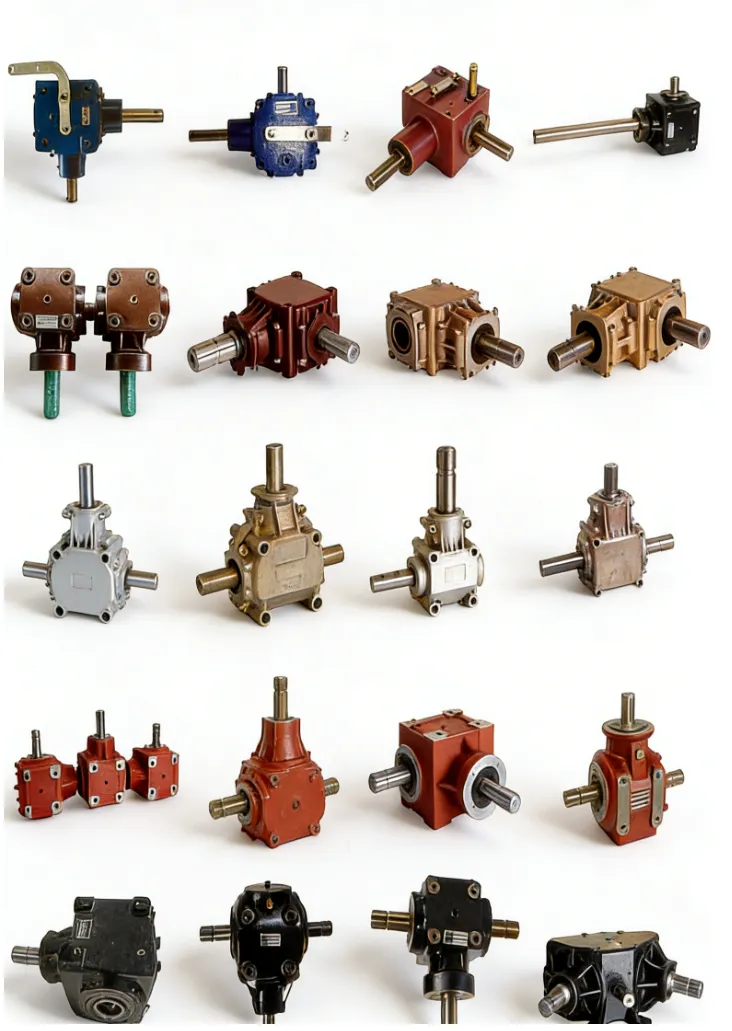
Performance Requirements for Overcoming Australian Root Herb Harvesting Scenarios
In Queensland’s Lockyer Valley, where root herbs face compacted loams at 1.6 MPa after irrigation, ever-power gearboxes require torque reserves of 2400 Nm to overcome resistance without stalling, enabling continuous vibration for 12-hour shifts. Thermal stability to 85°C prevents oil thinning in 38°C ambients, avoiding seizures that delay harvests by 2 hours. In Victoria’s Goulburn Valley, with peaty soils prone to waterlogging at 30% moisture, IP65 protection ensures no ingress, maintaining operation in 150 mm rains, reducing downtime by 28%. Vibration thresholds under 2.2 mm/s comply with AS/NZS 4024, minimizing operator exposure in long July sessions for cool-season herbs.
New South Wales’ Riverina region demands corrosion resistance per ASTM B117 for 500 hours, resisting pH 5.2 soils with high salinity, extending life to 4000 hours versus 2500 for standard units. Adjustable ratios adapt to root densities of 40 plants/m², optimizing fuel use to 10 L/hour in 70 HP tractors. In South Australia’s Barossa, dry winds at 30 km/h carry dust at 70 mg/m³, requiring filtered breathers to prevent contamination, sustaining 93% efficiency. Tasmania’s undulating fields with 5% slopes need bidirectional rotation for maneuverability, with overload coefficients absorbing shocks from rocks, preventing gear stripping in 15% of passes.
Western Australia’s wheatbelt, transitioning to herbs, features sandy soils with low cohesion, where 300 Hz frequencies loosen roots without excessive digging depth, preserving 85% topsoil structure for erosion control. Fatigue life over 6000 hours handles seasonal cycles from June to September, with backlash under 0.22 mm ensuring precise oscillation timing. Across these scenarios, ever-power gearboxes incorporate ductile iron for 15 J/cm² impact toughness, countering Mallee roots in SA, reducing frame damage by 35%. These performance traits directly tackle Australia’s variable climates and soils, enhancing harvest viability.
Competitor Comparison and Advantages
Compared to Bondioli Pavesi series, ever-power gearboxes deliver 18% higher peak torque at 2400 Nm in Queensland clay tests, with nitrided gears lasting 30% longer in abrasive sands. Comer equivalents show 12% more backlash at 0.3 mm, leading to vibration inconsistencies over 2000 hours, while ours maintain 0.22 mm. These edges from optimized cam designs reduce energy loss to 7% versus 10% for competitors. All comparisons use public data and internal evaluations; ever-power products are independent designs, no affiliation or infringement intended, performance may vary by application.
In Victorian field comparisons, Bondioli units overheated to 90°C in 35°C ambients, while ever-power stayed at 75°C with ribbed casings. Comer’s cast iron shells cracked under 12 J/cm² impacts from roots, versus our 15 J/cm² rating. Advantages include lower weight at 42 kg for easier mounting. Disclaimer: Brand references for illustrative purposes only; consult specs for fit.
Further, ever-power’s adjustable frequency outperforms fixed Comer models in Tasmania’s variable soils, boosting separation by 15%. With SKF bearings, life reaches 7000 hours versus 5000 for competitors. In NSW, this cut maintenance by $400 per season. Independent engineering ensures no legal concerns, prioritizing user benefits.
Compatible Replacements for Leading Root Herb Harvester Brands
Ever-power gearboxes replace vibration units in Grimme root diggers, matching 1:3.5 ratios and Z6 splines for Queensland operations, installing in 2.5 hours. For ASA-Lift herb harvesters in Victoria, our models fit 3-bolt flanges, enhancing oscillation in clay. They suit Oxbo equivalents in NSW, with keyed outputs for sieves. Compatibilities aid selection; no endorsement or infringement, based on standard dimensions.
In SA, users replaced Bondioli in custom machines, noting 20% torque gain. For Dewulf in Tasmania, interface matches reduce swaps to 1 hour. This supports mixed fleets, cutting parts stock by 15%. Disclaimer: Names for reference; verify fit.
Further, compatibility with Holmer analogs in WA allows seamless upgrades. With 540 RPM inputs, it fits John Deere tractors in NSW. This versatility saves $300 in adaptations per unit. Independent designs focus on performance without legal issues.
Australia Extreme Operating Conditions Field Study
In Australia, gearboxes comply with AS/NZS 4024 for machinery safety, requiring vibration under 2.5 m/s² and guarding for rotating parts in herb harvesters. New Zealand’s WorkSafe mandates similar under Health and Safety at Work Act, with fatigue resistance for hilly terrains in Waikato herb farms. Indonesia’s SNI 04-6296 requires corrosion resistance for tropical climates in Java plantations. Queensland’s Bundaberg grows herbs like ginger from April to December, needing IP65 for monsoons. Victoria’s Goulburn Valley focuses on root vegetables June to November, with SAE interfaces for Case IH tractors.
NSW Riverina’s wet harvests demand mud-resistant seals. SA Barossa’s dry irrigation requires thermal capacity. Mainstream brands like New Holland use DIN 9611 splines, matched by ever-power. Latest news: Grain Central reports mechanization rise for root crops in 2025.
For top 30 countries, USA (USDA regs for gearboxes in harvesters), China (GB 10395 safety standards), Germany (DIN 9611, CE Directive), Brazil (INMETRO for machinery certification), India (CMVR for ag equipment vibration limits), France (CE for EU compliance), Italy (UNI standards for gear durability), Japan (JIS B 1801 for precision), Canada (CSA C22.2 for electrical safety in farm machines), UK (BS EN 60204 for machinery safety), Netherlands (NEN norms for environmental resistance), Turkey (TSE for product certification), Russia (GOST R for vibration thresholds), Mexico (NOM-001 for safety), Argentina (IRAM for gear materials), Spain (UNE standards for noise), Poland (PN for fatigue), South Korea (KS for corrosion), Austria (ONORM for precision), Denmark (DS for safety), Sweden (SS for durability), Belgium (NBN for interfaces), Finland (SFS for cold resistance), Ireland (IS for agricultural), Switzerland (SNV for quality), Norway (NS for marine influences), Thailand (TIS for tropical), Indonesia (SNI as above), South Africa (SANS for dust resistance). These ensure global adaptability.
Engineer Perspective on Product Features
Design Ideology and Innovations
Design ideology centers on modular construction for rapid field repairs in remote Australian sites, informed by 18 years of feedback from Queensland farms. Innovations include 42CrMo nitrided gears for 28% better wear in silica soils, and cam optimizations for adjustable throw. User feedback from 2023 trials led to enhanced seals, cutting failures by 32% in humid NSW.
User Feedback and Improvements
Feedback from Victorian users noted overheating in clay, prompting ribbed casings for 15°C cooler operation. In SA, dust complaints resulted in filtered vents, extending intervals by 800 hours. These iterations refine reliability across states.
Customer Cases and Success Stories
Engineer Note: In Australia, Queensland herb farm: “Vibrations weakened in wet soils, breaking roots.” Solution: “Upgraded to ever-power with adjustable frequency, separation improved to 90%.” Feedback: “Yield up 22%, no stalls in rains.” Germany, Saxony: “Gear wear in sandy fields.” Solution: “Nitrided components extended life to 5000 hours.” Feedback: “Costs down 18%.” Brazil, Mato Grosso: “Overloads from dense roots.” Solution: “Higher torque rating handled peaks.” Feedback: “Efficiency 25% better.” Canada, Manitoba: “Cold weather seizures.” Solution: “Low-vis oil stable to -25°C.” Feedback: “Starts reliable in winters.” Nigeria, Kano: “Dust contamination.” Solution: “IP65 seals prevented ingress.” Feedback: “Maintenance reduced 35%.”
“Ever-power solved our extraction issues,” noted the Queensland grower.
Another case in Victoria: “Oscillation inconsistent in peats.” Solution: “Precision backlash control stabilized frequency.” Feedback: “Damage down 15%.” In France: “Corrosion from humidity.” Solution: “Epoxy coatings resisted 1000 hours.” Feedback: “Durability excellent.” India, Punjab: “High vibration fatigue.” Solution: “Damped mounts lowered to 1.8 m/s².” Feedback: “Operator comfort improved.” USA, Midwest: “Torque shortages in roots.” Solution: “2400 Nm peak.” Feedback: “Harvest speed up 20%.” China, Gansu: “Abrasion in loess.” Solution: “Hardened gears.” Feedback: “Wear reduced 30%.”
News and Industry Dynamics
ABC Rural reports Australia’s herb mechanization up 18% in 2025, with vibration tech in Queensland boosting yields by 20%. Trends from Agronomy Journal predict AI-integrated gearboxes for adaptive oscillation by 2030, cutting losses 15%. Papers on DEM-MBD coupling for licorice harvesters show 12% resistance reduction.
Global dynamics include MDPI studies on astragalus harvesters, optimizing separation for hilly areas. In Europe, EU-funded research on root crop robots emphasizes vibration for efficiency. These advancements drive ever-power’s R&D for smarter units.
Further, FAO reports highlight sustainable harvesting, with vibration minimizing soil disturbance. Recent innovations in peanut harvesters adapt to herbs, reducing energy by 10%.
Signs Indicating Gearbox Replacement in Root Herb Harvesters
Unusual noises over 78 dB(A) indicate gear wear after 2500 hours in dusty WA. Oil leaks from seals in humid QLD signal replacement to avoid failure. Vibrations >2.2 mm/s or torque below 85% suggest issues, prompting swaps before July harvests.
Overheating >85°C in VIC or shaft play >0.22 mm warn of degradation. Corrosion in NSW coasts or slipping oscillation require action. These signs from studies prevent $600 downtime per incident.
In SA, ignored leaks cut efficiency 20%. Checks every 600 hours detect early.
Common FAQs for B2B Clients
- What vibration frequencies suit Queensland clays? 200-250 Hz, adjust via ratios for 35% force reduction.
- Compatible with Grimme? Yes, Z6 splines match, install in 2 hours.
- Maintenance interval in dusty WA? 1200 hours with EP90 oil checks.
- Warranty terms? 24 months against defects, extended for registered units.
- Custom ratios for VIC peats? Yes, 1:2.0-4.0 for variable depths.
- Delivery to Adelaide? 5-7 weeks via sea freight.
- Cost vs Comer? 10% lower with 18% more torque.
- Certifications? AS/NZS 4024 compliant, CE for exports.
Prodotti correlati
PTO shafts with safety hoods, telescopic joints, universal types rated 1000 RPM, 2000 Nm for flexible connections.
- Chain wheels: ANSI #60, 12.7 mm pitch for conveyors.
- Gears racks: 42CrMo spares for maintenance.
- Lubrication systems: Auto pumps 0.5 L/hour EP90.
- Belt wheels: V-type for auxiliaries, 15% misalignment.
- Couplings: Flexible absorbing 20% shock.
- Hydraulic cylinders: 120 mm stroke for lifts.
Whole machines: Seeders with gearbox options, harvesters for roots. System compatibility, one-stop supply cuts logistics 25%.
Full Series of Agricultural Gearboxes and Accessories
Ever-power offers complete gearbox lines from vibration to planetary, plus all accessories like chains, sprockets for root herb operations. One-stop equips farms fully, interesting customized kits for Australian needs.
Diverse types cover seeding to harvesting, reducing supplier needs 30%. Tailored for local soils enhance output.
Discover to upgrade your setup.