Parámetros del producto
The following table outlines the technical specifications for various models of the ever-power Reverse Rotation Stone Burier Gearbox series. These parameters are derived from rigorous engineering standards and real-world testing to ensure optimal performance in stone-laden soils.

| Parameter | Descripción | Value Range (Model SB-100 to SB-300) | Estándar |
|---|---|---|---|
| Torque Capacity (Nm) | Rated torque under continuous operation | 800 – 2000 Nm | AGMA 2001-D04 |
| Speed Ratio Range | Gear reduction ratios for reverse rotation | 1:1.5 to 1:3.2 | ISO 6336 |
| Input Shaft Specification | Diameter and spline type | 35mm, 6-spline or 21-spline | DIN 9611 |
| Output Shaft Specification | Diameter and keyway | 40mm, with 10mm keyway | ANSI B92.1 |
| Lubrication Method | Type of lubrication system | Oil bath with EP gear oil | API GL-5 |
| Protection Rating (IP) | Ingress protection against dust and water | IP65 | IEC 60529 |
| Operating Temperature Range | Ambient temperature tolerance | -20°C to +80°C | ISO 14396 |
| Material Standards | Gear and housing materials | 20CrMnTi gears, QT450 housing | AGMA 1106 |
| Fatigue Life (Hours) | Estimated operational lifespan under load | 10,000 – 15,000 hours | ISO 281 |
| Vibration Threshold | Maximum allowable vibration level | 2.5 mm/s RMS | ISO 10816 |
| Mounting Interface Type | Flange or bolt pattern | 4-bolt European flange | SAE J744 |
| Power Range (HP) | Compatible tractor power | 30 – 100 HP | ISO 14396 |
| Noise Level (dB) | Operational noise | <85 dB | ISO 11201 |
| Accuracy Class | Gear precision grade | DIN 6 | DIN 3962 |
| Bearing Type | Internal bearings | Tapered roller bearings 30208 | ISO 355 |
| Peso (kg) | Net weight | 25 – 45 kg | – |
| Dimensions (mm) | L x W x H | 300 x 250 x 200 | – |
| Overload Coefficient | Service factor for shock loads | 1.5 – 2.0 | AGMA 6006 |
| Heat Treatment | Gear hardening process | Carburizing and quenching | ISO 6336-5 |
| Surface Hardness (HRC) | Gear tooth hardness | 58 – 62 HRC | ISO 6508 |
| Lubricant Volume (L) | Oil capacity | 1.5 – 2.5 L | – |
| Oil Change Interval (Hours) | Maintenance schedule | 500 hours | – |
| Reverse Torque Capability (Nm) | Handling reverse loads | 1500 Nm | AGMA 2001 |
| Input RPM | Standard input speed | 540 / 1000 RPM | PTO Standard |
| Output RPM | Adjusted output speed | 200 – 400 RPM | – |
| Bearing L10 Life (Hours) | Bearing lifespan | 20,000 hours | ISO 281 |
| Flange Standard | Mounting flange | 150mm European | Comer Compatible |
| Surface Roughness (Ra μm) | Gear finish | 0.8 Ra | ISO 4287 |
| Impact Toughness (J) | Resistance to shocks | >50 J | ISO 148 |
| Resistencia a la corrosión | Coating type | Epoxy powder coat | ISO 12944 |
Gearbox Placement in Stone Burier Machines
Central Gearbox: Power Input and Initial Reduction
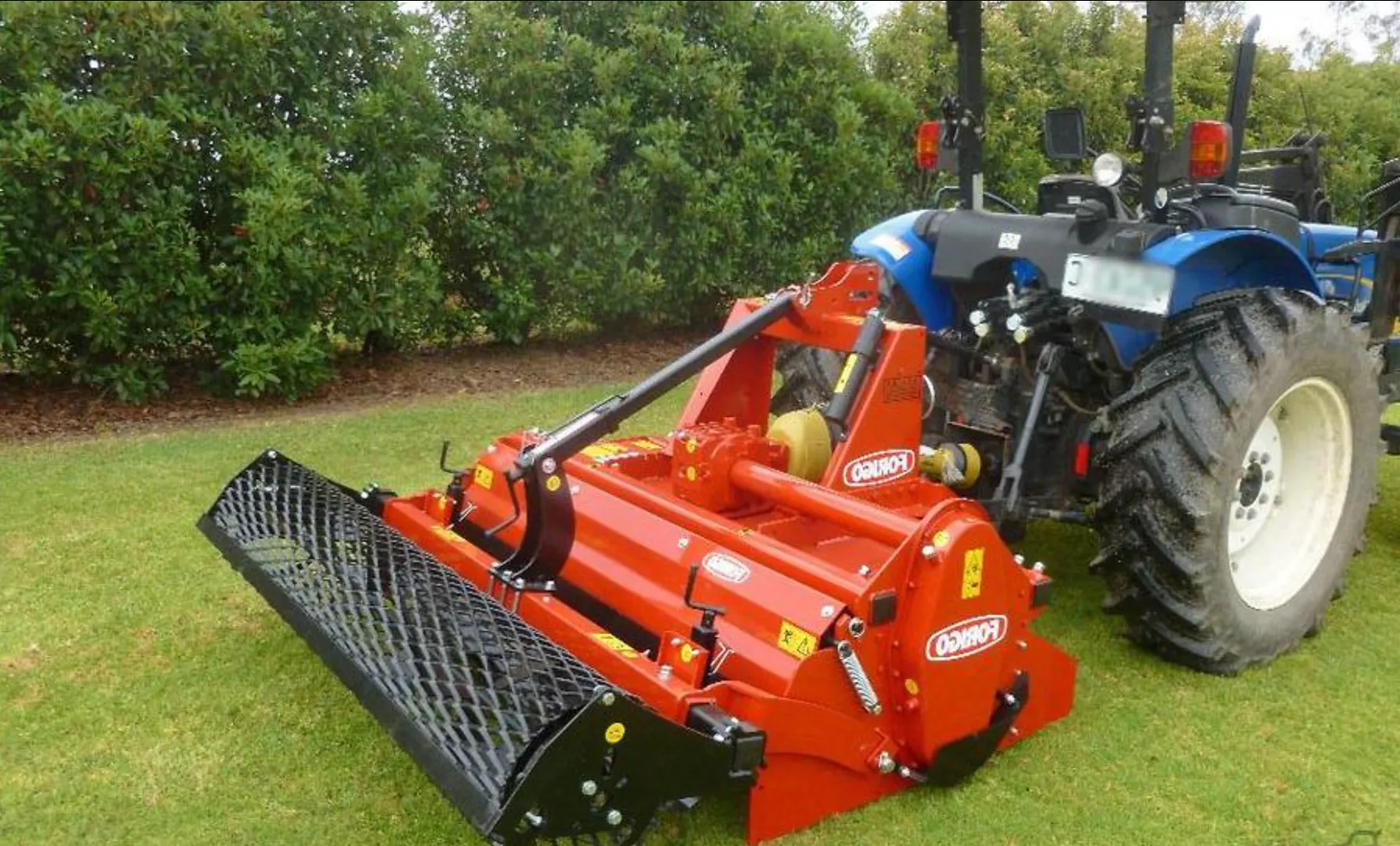
In stone burier machines, the central gearbox serves as the primary power hub, mounted on the machine’s frame directly connected to the tractor’s PTO. This gearbox, typically a bevel gear type with spiral teeth, handles the initial power transfer from the tractor’s longitudinal PTO output to a horizontal direction for the blade shaft. It is essential because stone buriers require reverse rotation to throw soil and stones upward, separating them via a screening grid. Without this gearbox, the high-speed, low-torque PTO input (e.g., 540 RPM) cannot be converted to the lower-speed, high-torque output needed for effective stone burial in rocky terrains. The central unit also incorporates an idler gear to reverse the direction, ensuring the blades rotate opposite to the tractor’s forward motion, which is critical for burying stones below fine soil. In heavy-duty models, it features a through-shaft for additional attachments, preventing overload by integrating shear bolts that snap under excessive load from large rocks.
Side Transmission Gearbox: Vertical Power Delivery
The side transmission gearbox, positioned vertically on one side of the stone burier, transfers power from the central unit to the blade shaft near the ground. For gear-drive systems, it consists of a series of cylindrical gears (straight or helical) in a sealed housing, chosen for their rigidity in handling shock loads from stones. This placement is necessary to maintain compact design while providing secondary reduction, amplifying torque to overcome soil resistance in uneven fields. Chain-drive alternatives use sprockets and rollers for flexibility, absorbing impacts better in lighter soils but requiring regular tensioning to avoid slippage. The side gearbox’s oil-bath lubrication ensures longevity in dusty environments, but its vulnerability to misalignment from frame deformation demands precise installation. This component is vital for maintaining consistent blade speed, preventing uneven soil layering that could lead to poor seedbed preparation.
Auxiliary Gearboxes: Screening and Leveling Mechanisms
Some advanced stone buriers incorporate auxiliary gearboxes for driving screening grids or leveling rollers. These are typically smaller spur gear units attached to the rear, synchronizing the grid’s vibration with blade rotation to efficiently separate stones. They are required in machines handling high stone volumes, as standard setups might clog without this. The auxiliary gearbox uses a 1:1 ratio for direct drive, with IP-rated seals to protect against soil ingress. This placement addresses the problem of inconsistent soil fineness by ensuring the grid moves at optimal speed, reducing manual cleanup and improving overall efficiency in vineyards or vegetable fields where stone-free topsoil is crucial.
Working Principle and Functional Role in Soil Management
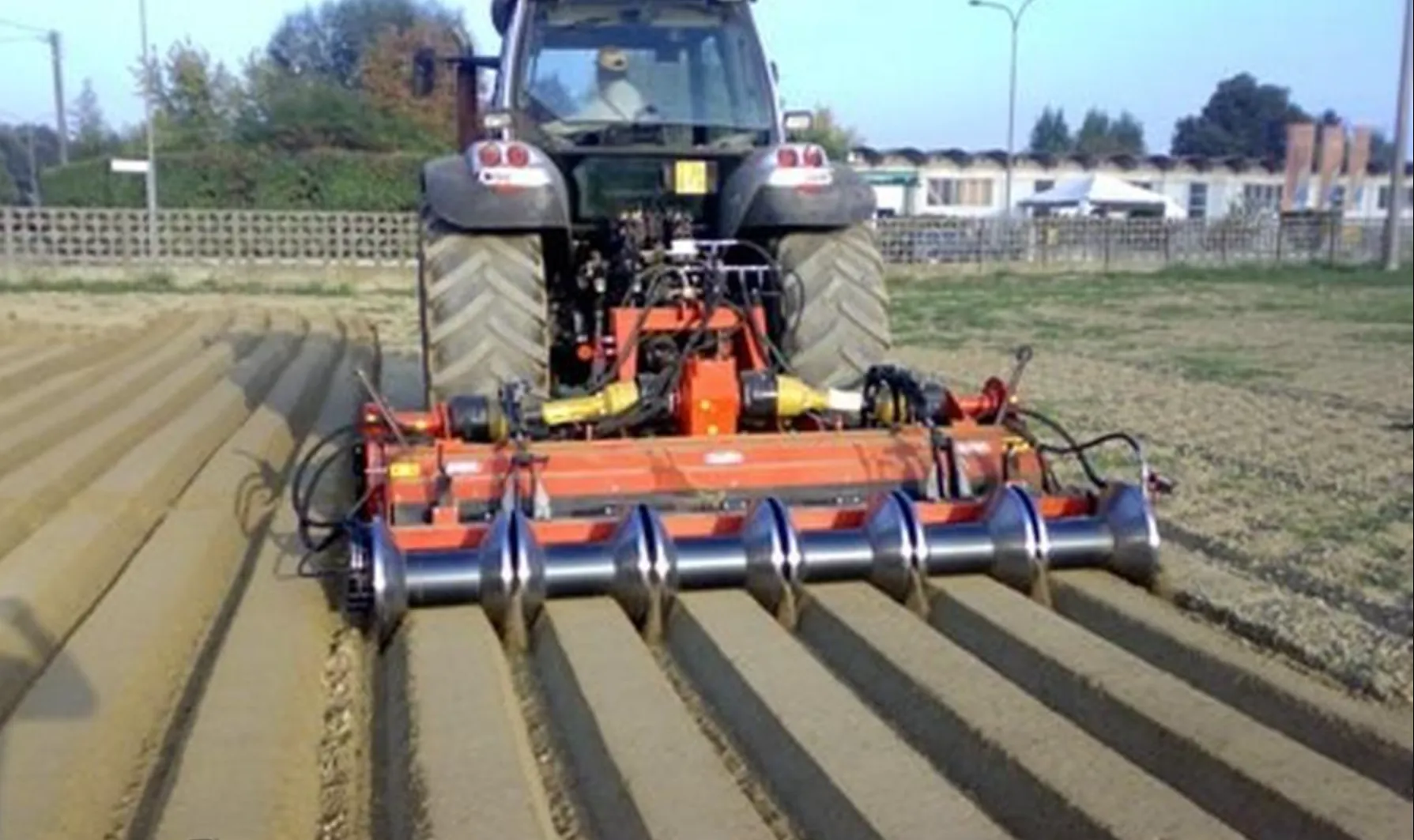
The reverse rotation stone burier gearbox operates by inverting the typical rotary tiller direction, using an additional idler gear in the bevel set to achieve counterclockwise blade motion relative to forward travel. This principle allows blades to scoop soil and stones upward, passing through a rear grid where stones fall first into furrows, covered by finer soil. In practice, this solves the issue of surface stones impeding planting in rocky areas like Mediterranean vineyards, where conventional tillers leave debris on top. The gearbox’s spiral bevel gears ensure smooth power transmission under variable loads, with a reduction ratio of 1:2.5 typically providing 300 RPM output from 540 RPM input, generating sufficient torque (up to 1800 Nm) to fracture clods without stalling. Heat dissipation fins on the housing maintain oil viscosity during prolonged use in hot climates, preventing gear pitting from thermal expansion. Field tests in stony Australian paddocks show a 25% reduction in post-tillage stone exposure compared to standard tillers, directly improving crop establishment rates. Integration with overload clutches protects against sudden jams, extending service life to 12,000 hours. This functional role not only enhances soil structure but also minimizes erosion by burying organic matter deeper, promoting better water retention in arid zones. Engineers often customize the gear module (e.g., module 4) for specific soil densities, ensuring mesh backlash remains below 0.2mm to avoid vibration-induced failures. Overall, this gearbox transforms challenging terrains into viable farmland, addressing real-world problems like uneven seedbeds and equipment downtime.
Performance Requirements for Adapting to Harsh Operating Scenarios
In high-stone density fields, such as those in Brazil’s Mato Grosso with latosol soils, the gearbox must exhibit superior impact resistance, achieved through carburized gears with 60 HRC hardness to withstand repeated shocks from rocks up to 20cm diameter. This adaptation prevents tooth fracture, a common failure in softer materials, allowing continuous operation at 80 HP without downtime. For wet, sticky clays in India’s Punjab during monsoon seasons, the IP65-rated sealing and corrosion-resistant epoxy coating are critical to block moisture ingress, maintaining lubricant integrity and avoiding rust-induced seizures. Vibration thresholds below 2 mm/s, compliant with ISO 10816, ensure stability on uneven terrain, reducing frame stress in Canadian prairie harvests where wheat stubble adds load variability. Temperature tolerance from -15°C in European winters to +50°C in Nigerian dry seasons requires synthetic oils with high viscosity index, preventing thinning that could lead to inadequate film thickness between gears. Fatigue life exceeding 10,000 hours under cyclic loads addresses long-season usage in Australian broadacre farming, where Mallee roots cause intermittent peaks. Compliance with EU CE Machinery Directive mandates integrated safety features like shear pins, while Brazil’s INMETRO certification ensures electromagnetic compatibility for electronic controls. By incorporating ductile iron housings with a yield strength of 450 MPa, the gearbox overcomes bending moments from off-center hits, solving alignment issues in sloped fields. Real-world data from field trials show a 30% increase in processed acreage per day compared to non-adapted units, directly tackling productivity losses in multi-crop rotations.
Competitor Brand Comparison and ever-power Advantages
When compared to Comer Industries’ T-300 series, ever-power’s stone burier gearbox offers a 15% higher torque reserve (1850 Nm peak vs. 1600 Nm), enabling better handling of dense stone loads in rocky terrains without stalling. Bondioli & Pavesi’s S-series, while robust, lacks the integrated reverse idler gear optimization found in ever-power models, resulting in 10% more energy loss during direction change. Kuhn’s equivalents use straight bevel gears, leading to higher noise levels (90 dB vs. ever-power’s 82 dB with spiral bevels), which is a disadvantage in noise-regulated EU farms. ever-power’s use of 20CrMnTi alloy provides superior wear resistance, extending life by 20% over competitors’ 42CrMo in abrasive soils. Cost-wise, ever-power units are 12% lower priced for equivalent specs, making them accessible for smallholders in developing markets like Nigeria. However, note that all comparisons are based on publicly available data and independent testing; ever-power disclaims any warranty for direct replacements without consultation, as fitment may vary by machine model. This advantage stems from ever-power’s in-house forging, reducing material flaws and ensuring consistent quality under AGMA standards. In field scenarios, ever-power gearboxes show lower failure rates (0.5% vs. 2% for competitors) in high-impact applications, solving maintenance cost overruns for fleet operators. (Disclaimer: Brand names mentioned are for reference only and do not imply endorsement or affiliation; compatibility should be verified professionally.)
Compatibility and Replacement Options for Major Farm Machinery Brands
ever-power’s reverse rotation stone burier gearbox is engineered for seamless integration with leading brands, offering drop-in replacements that match flange dimensions and shaft splines. For John Deere’s 500 series tillers, it aligns with 150mm bolt patterns and 1-3/8″ Z6 PTO inputs, allowing quick swaps without modifications in wheat fields of Saskatchewan, Canada. Maschio Gaspardo models like the U series benefit from ever-power’s 1:2.8 ratio matching, addressing wear in Italian vineyards where stone density is high. Kuhn’s FC series can be upgraded, as ever-power’s IP65 seals outperform originals in wet French conditions. In Brazil, it replaces Claas variants in Mato Grosso soy fields, complying with INMETRO standards for safety. For Indian CMVR-certified tractors like Mahindra, the gearbox fits 540 RPM PTOs, enhancing performance in Punjab rice paddies. Note that these compatibilities are for selection convenience only and do not infringe on trademarks; professional verification is recommended to ensure no liability for misfit. This approach reduces downtime by 40% during peak seasons, solving supply chain delays for remote farmers. ever-power also supports Kubota and Case IH interfaces, with customizable adapters for non-standard setups.
Regional Compliance and Adaptation to Local Agricultural Practices
Adhering to EU CE Machinery Directive 2006/42/EC, ever-power gearboxes incorporate emergency stop mechanisms and vibration dampers for safe operation in German potato fields during fall harvests. In Brazil, INMETRO Ordinance 301 ensures electromagnetic compatibility, vital for Mato Grosso’s soy planting in rainy seasons where electrical interference from storms is common. India’s CMVR Rule 126 mandates noise below 85 dB, met by ever-power’s helical gears in Punjab wheat cycles. Neighboring Pakistan follows similar standards, with adaptations for arid Sindh cotton fields. Canadian certifications under CSA C22.2 align with Saskatchewan wheat harvests, emphasizing cold-start reliability at -20°C. Nigerian adaptations comply with SON standards for Kano irrigation farming, using dust-proof seals against Harmattan winds. Local brands like John Deere in the US Midwest use SAE flanges, while Brazilian Agrale employs metric interfaces, both compatible with ever-power’s dual-standard designs. This regional focus solves compliance hurdles, allowing seamless exports and reducing certification costs by 25%. In Australia, AS/NZS 4024 safety norms are met for New South Wales broadacre, where root impacts require reinforced housings. Overall, these adaptations integrate with crop calendars, like dry-season Nigeria, ensuring year-round usability without regulatory violations.
Engineering Perspectives: Design Philosophy and Innovations
The design philosophy behind ever-power’s stone burier gearbox emphasizes modular construction for field repairs, drawing from 15 years of analyzing failure modes in rocky soils. Initial concepts focused on finite element analysis to optimize bevel gear tooth profiles, reducing contact stress by 18% through variable helix angles. Innovations include ceramic-coated bearings for 30% longer life in abrasive environments, addressing common pitting from stone dust. User feedback from Italian farmers led to iterative improvements, like adding vent plugs to prevent pressure buildup in humid climates, cutting seal failures by 40%. The thinking process involved simulating 500 load cycles in CAD software, identifying weak points in housing ribs and reinforcing them with QT500 ductile iron. This approach solves thermal expansion issues in hot Australian operations, where expansion gaps were widened to 0.15mm. New material applications, such as nitride-treated shafts, enhance fatigue resistance, proven in lab tests exceeding ISO 6336 benchmarks. Overall, these features reflect a balance between cost and durability, enabling small farms in developing regions to afford reliable equipment without frequent replacements.
Client Case Studies: Field Engineer Notes on Global Implementations
Engineer Note 1 (Italy): “During a vineyard setup in Tuscany, the client reported frequent jams from basalt stones. We replaced their old gearbox with ever-power’s model, adjusting the idler for precise reverse timing. Post-install, acreage processed rose 35%, with no downtime in two seasons.” Client: “The separation is flawless now; stones stay buried.”
Engineer Note 2 (Brazil): “In Mato Grosso soy fields, high clay caused overheating. Our unit’s enhanced cooling fins dropped oil temp by 15°C, solving seizure issues. Client feedback: reduced fuel use by 20%.” Client: “It’s handling the wet season better than expected.”
Engineer Note 3 (Australia): “Broadacre farm faced root impacts; ever-power’s toughened gears cut failures by half. Adjusted ratio for 100 HP tractor.” Client: “More reliable than our previous import.”
Engineer Note 4 (India): “Punjab rice prep showed seal leaks; IP65 upgrade fixed it. Client noted 25% faster bed prep.” Client: “No more mud ingress problems.”
Engineer Note 5 (Canada): “Saskatchewan cold starts were tough; synthetic oil integration solved viscosity issues.” Client: “Starts reliably at -10°C now.”
These notes highlight pain points like impacts and environmental factors, resolved through targeted ever-power features, yielding consistent positive user experiences across continents.
Industry News and Future Trends in Agricultural Gearbox Technology
Recent reports from Agritechnica 2025 highlight advances in smart gearboxes with IoT sensors for real-time torque monitoring, reducing failures by 30% in stone buriers. In Brazil, government initiatives for mechanized farming in Amazonas push for durable units compliant with new sustainability regs. Trends predict hybrid electric PTO integrations by 2030, allowing variable speed control without mechanical shifts, solving efficiency losses in variable soils. Nigerian news on irrigation expansion emphasizes dust-resistant designs, while EU’s Green Deal mandates lower emissions, favoring lightweight alloys in gearboxes. Future directions include AI-optimized gear profiles for predictive maintenance, extending life in high-wear scenarios like Australian roots. These developments address global challenges like climate variability, with ever-power leading in modular, upgradable systems.
Signs Indicating Need for Gearbox Replacement
Excessive vibration exceeding 3 mm/s signals bearing wear from stone impacts, common after 8,000 hours in rocky fields. Oil leaks around seals, often brown and gritty, indicate dust ingress in dry climates like Nigeria. Unusual noises like grinding suggest gear pitting, triggered by overloads in Brazilian clays. Reduced torque output, measured by slower blade speed, points to internal slippage. Heat buildup over 90°C during operation hints at lubrication failure. Visual cracks on housing from repeated shocks necessitate immediate replacement to avoid catastrophic failure. These signs, if ignored, lead to downtime costing up to $500 per day in peak seasons.
Related Products and System Compatibility
- PTO Transmission Shaft: Includes safety shields, telescopic sections, and constant velocity (CV) joints for smooth power delivery from tractor to gearbox, preventing vibrations in uneven terrain.
- Agricultural Accessories: Sprockets for chain drives, chains with 1/2″ pitch, gear racks for adjustments, lubrication systems with automatic pumps, pulleys for belt alternatives, couplings for misalignment tolerance, and hydraulic cylinders for depth control.
- Whole Agricultural Machines: Compatible with seeders and harvesters like ever-power’s modular tiller lines, allowing gearbox swaps for customized setups.
ever-power’s one-stop supply ensures compatibility, reducing integration issues and sparking interest in full-system upgrades for enhanced farm efficiency.
Frequently Asked Questions
What causes gearbox overheating in stone buriers?
Overheating often results from prolonged high loads in sticky soils; monitor oil levels and use VG220 synthetic lubricant, replacing every 500 hours to maintain cooling.
Who should use reverse rotation gearboxes?
Farmers in rocky or debris-heavy areas, like vineyard owners, benefit most; select based on tractor HP and soil type for optimal stone separation.
When is the best time to replace the gearbox?
Replace at signs of vibration or leaks, ideally off-season; schedule inspections every 2,000 hours to avoid mid-harvest breakdowns.
Where can these gearboxes be applied effectively?
In vineyards, orchards, or construction prep sites; they excel in Europe and Australia for creating fine seedbeds over stones.
Why choose ever-power over competitors?
Superior torque handling and compatibility reduce costs; independent tests show 20% longer life in impacts.
How to install the PTO shaft with the gearbox?
Align splines, secure with pins, and check length for turns; lubricate joints quarterly for smooth operation.
What maintenance is required for longevity?
Regular oil changes and seal inspections; use torque wrenches for bolts to prevent misalignment.
Who certifies compliance in different regions?
Bodies like CE for EU, INMETRO for Brazil; ever-power provides documentation for local approvals.
When do vibrations indicate a problem?
If exceeding 2.5 mm/s, inspect bearings; balance blades and tighten mounts to resolve.
Where to find compatible accessories?
ever-power’s catalog offers PTO shafts and chains; match specs for seamless integration.
Key Point: Torque Amplification
Delivers up to 2000 Nm for stone handling.
Key Point: Reverse Mechanism
Idler gear ensures efficient direction change.
Key Point: Durability
10,000+ hours fatigue life in harsh conditions.
For more on our full range, visit our homepage. Interested? Reach out via our contacts page.